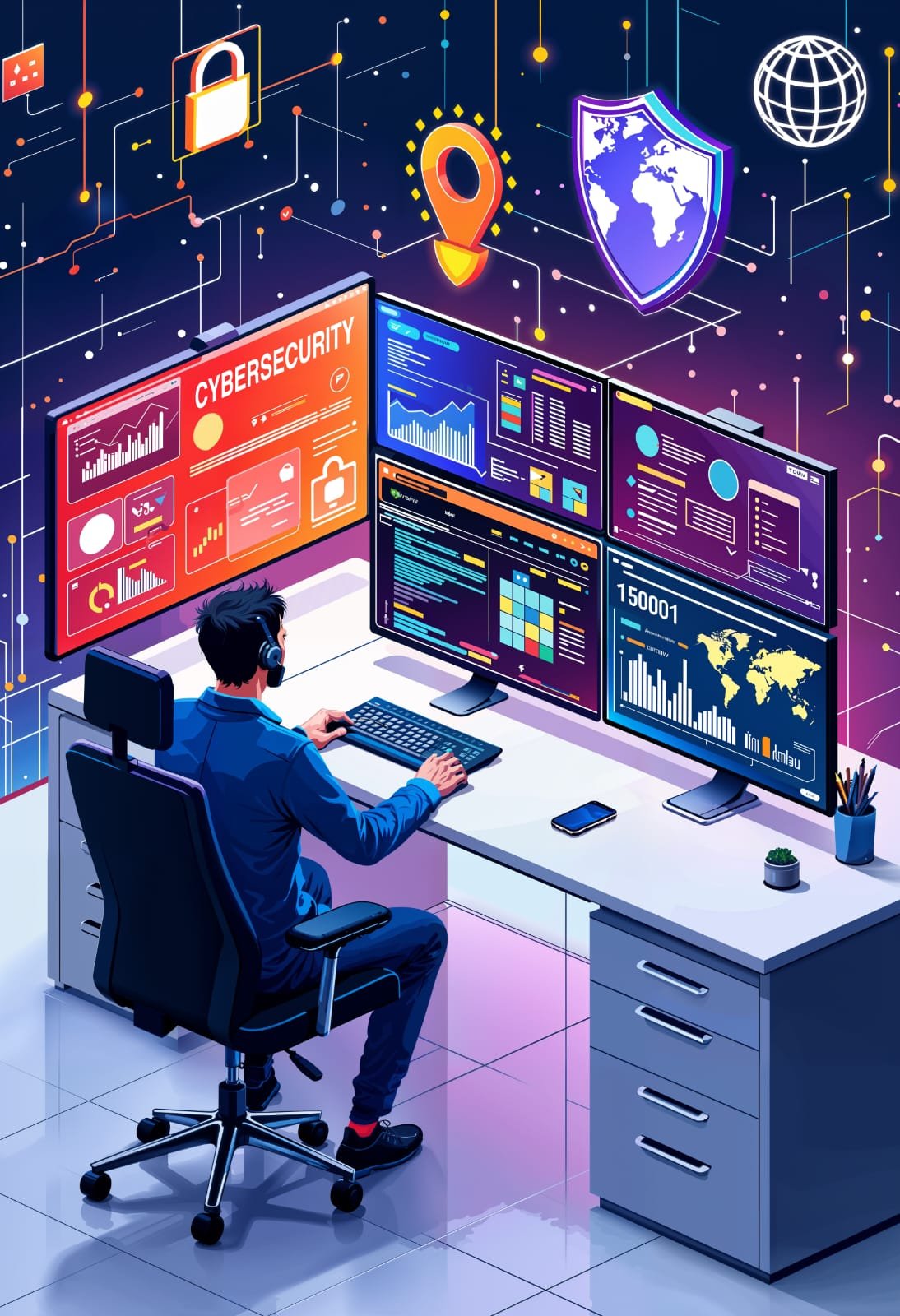
In today’s digital world, cybersecurity is more than just a technical requirements a core part of doing business. Businesses now rely on digital systems, cloud computing, and interconnected networks to conduct their business, which, unfortunately, also means that they are now at greater risk to cyber threats. Cyber threats come in many forms, including ransomware and phishing attacks, insider threats, and large-scale data breaches, each presents its own set of risks and are constantly changing. Kode Digital helps businesses realize that cyber security is a continuous, strategic process versus just an initial, onetime implementation. By leveraging multiple disciplines (risk assessment/Risk Mitigation, architecture design, advanced protection mechanisms, and real-time monitoring), Kode Digital enables you to build a solid foundation for a flexible and adaptable defense network. The purpose of this article is to provide in-depth information about the essential components of each of Kode Digital core cyber security services so that businesses can be fully informed of the components of these services as well as the significant reasons they must implement these services.
A well-built cyber security framework will always begin with operational consideration of your organisation’s risk framework. Security risk assessment is not just about finding vulnerabilities, it is also about understanding how the vulnerabilities exist and potentially operate, what might happen if these vulnerabilities were exploited, and how likely it is for these vulnerabilities to be exploited against your organisation.
As part of this process, the first step is to identify all the digital assets in an organization, including servers, applications, endpoints, and databases. Once the organization has completed this identification of their assets, they will analyze all potential threat actors to see if they present any risks to their digital assets. These threat actors include both internal and external parties who may breach an organization’s network either intentionally (through cyberattack) or unintentionally (through accidental disclosure). Next, an organization will perform a detailed vulnerability assessment of their assets to find weaknesses within those assets, including things like outdated software, weak authentication mechanisms, poorly configured systems, and numerous other items.
Once the organization has conducted assessments of their digital assets and vulnerability assessments have been conducted, the third step in this process is the evaluation of the risk of the vulnerabilities and the prioritization of those risk based upon potential business impact. This is important because there are varying levels of of severity of vulnerabilities, i.e., some have little or no negative impact to a business, while others may have significant financial or reputational impact to the business. Kode Digital uses structured frameworks and methodologies in their risk assessments to ensure that assessments performed are both accurate and actionable. The result of conducting these assessments results in an actionable roadmap that organizations can use to help them focus their resources on the most critical security deficiencies first, thereby reducing their exposed risk and improving their overall resiliency.
This part of the article covers the function and essential nature of the network as it provides the connection between an organisation’s users and systems, thus there needs to be appropriate protection of the network so that it cannot be used as an entry point for cyber attacks on the organisation’s digital assets. The creation of network security architecture can be enhanced with multilayered defence-in-depth strategy as well as just implementing firewalls.
In recent years, modern network security has undergone a transformation compared to traditional according to perimeter-based security models. The increase in remote work, cloud technology and the use of mobile devices has created a situation where the notion of having a defined network perimeter is no longer valid. Consequently, organisations must take a more flexible approach to network protection based on the fact that threats could come from any location. As such, the concept of zero-trust architecture becomes very important in order to validate every user and device connected to the network.
Kode Digital is focused on developing secure and scalable network architectures. Examples of this would be the implementation of sophisticated intrusion detection systems that actively monitor network traffic for any suspicious activity, network segmentation to limit lateral movement by an attacker, and ensuring secure communication between systems where applicable. If businesses design their networks to reduce the exposure of the organisation and implement strict access controls, then the potential for cyber attacks will be eliminated.
Devices that connect to a network such as laptops, smartphones, and servers are some of the weakest links in most organizations’ IT infrastructures. Because of this, endpoints may allow cybercriminals easy access to an organization’s network. Furthermore, as more people work from home and use their own devices, the complexities to secure those devices increase as well.
Typically, endpoint protection is referred to as antivirus software, which protects against known threats. Cybercriminals frequently use advanced techniques that allow them to bypass traditional antivirus protection, this is where advanced endpoint protection or endpoint detection and response (EDR) solutions are necessary. EDR solutions continuously monitor, alert, and respond to unusual activity on devices.
At Kode Digital, we utilize multiple layers of security to protect our endpoints, thus, we ensure that all devices on our network are secured on many different levels. This includes leveraging patch management to remediate known vulnerabilities, encrypting data on all endpoints, and utilizing behavioral-based analysis to identify newly discovered threats. By utilizing layers of security focused on both prevention and rapid response, businesses are at a lower risk for endpoint-based attacks and can quickly contain any breaches that do occur.
Cloud computing has significantly changed how companies function due to the flexibility, scalability, and cost-effectiveness of cloud-based services, however, as with anything new, it presents various security risks requiring specialized solutions. Unlike traditional IT environments, where security controls and responsibilities typically lie solely with the organization storing the information in its own databases or servers, cloud security is a collaborative effort between service providers and organizations, so it is necessary to understand each party’s security controls and on their management processes.
Misconfiguration is one of the leading causes of risk in cloud environments. Even simple mistakes like making storage buckets publicly accessible or not enforcing strong access control could put sensitive data into the hands of an unauthorised user. Additionally, many companies use multiple types of cloud platforms which can lead to inconsistent security policies across all platforms, increasing the likelihood of having gaps or vulnerabilities in their security.
Kode Digital is addressing these issues by implementing comprehensive cloud security strategies for every stage of the cloud lifecycle, including secure migration processes, solid identity and access management systems, and continuous monitoring to detect and fix any present issues. When organizations know their cloud environments are properly configured and consistently managed, they can take advantage of everything cloud technology has to offer while still having the security necessary to protect their information.
Typically, data is the number one resource or asset for every business, therefore, it is the first target of cybercriminals. Safeguarding data requires the use of multiple mechanisms (policies, technology, and processes) to always preserve confidentiality, integrity, and availability.
Encryption is one of the best ways to protect data because it transforms data to a format that cannot be read, thus, even if someone intercepts or gains access to that data without authorisation, they cannot read it without having the proper decryption key. This is especially true for sensitive data such as, customer data, financial records and intellectual property.
Kode Digital approaches data protection from a comprehensive perspective, protecting data during its entire lifecycle. This includes, strong access controls to limit who is allowed to view or change data, employing advanced encryption techniques to protect data while at rest and during transmission, and implementing reliable data backup and recovery systems to prevent data loss. Through these actions, organisations will be able to protect their most valuable assets and retain the trust of their customers and other stakeholders.
Cybersecurity is a fluid ongoing activity – we must keep a watchful eye on all aspects of our security. A quality, well-designed system can be “hacked”, if it doesn’t have continuous monitoring to detect and respond to unusual patterns of activity. We need to monitor overall what is happening in an environment to give ourselves the ability to respond rapidly to threats.
The security monitoring activity is supported by a variety of technical components including systems that gather data about what is taking place in different parts of the system, e.g., network traffic, user activity and system/database log files. These systems will utilize advanced analytics and threat intelligence to understand patterns of activity and will help identify emerging threats that have a high likelihood of leading to an attack. The earlier you are able to detect a threat, the sooner you will be able to respond and prevent significant damage.
Kode Digital provides security monitoring service 24/7. Your organization’s security is continuously monitored and threats are identified and acted on quickly. By employing automated tools and artificial intelligence, Kode Digital security monitoring systems are able to process large amounts of data quickly and provide timely detection and response to incidents. This proactive approach not only enhances an organization’s security posture, but also assists an organization in maintaining business continuity when faced with potential threats.
Organizations need to comply with many regulatory requirements relating to cybersecurity, which are designed to ensure the responsible handling of sensitive information and the implementation of adequate security controls.
Compliance is about more than just avoiding penalties, it is essential for building trust with customers, business partners, and other stakeholders. Organizations that exhibit good governance practices will typically be viewed as trustworthy and secure. However, compliance can be difficult due to the numerous regulatory requirements faced by organizations operating in multiple regions or industries.
Kode Digital offers services that assist organizations in meeting their compliance obligations by creating clear governance frameworks and aligning their security practices with appropriate industry standards, including developing policies and procedures, conducting periodic reviews, and documenting and enforcing all security measures. By integrating compliance activities within the overall cybersecurity program, organizations can reduce risk and improve their operational performance.
Choosing the right Cybersecurity Tools (Sec-T), and using them effectively, is a vitally important part of building a secure environment. There is an overwhelming abundance of solutions available in the marketplace for organizations to choose from, frequently leading organizations to have difficulty identifying which Sec-T solution will meet their needs. The result of improper selection or use can be significant resource waste and weak security measures.
Kode Digital provides the expertise to assist organizations with the procurement and implementation of Sec-T solutions to ensure organizations only invest in Sec-T solutions that meet their specific needs. The procurement and implementation involve, among other things, evaluating various technologies, assessing the capabilities of vendors, and considering items like scalability, compatibility, and cost-effectiveness.
Once the correct Sec-T Solutions have been selected, proper implementation is necessary for them to function as designed, including but not limited to correct system configurations, integration with the existing infrastructure, and testing to determine the security solution’s effectiveness. Kode Digital is also committed to the continual optimization of Sec-T solutions by ensuring that the security tools are regularly updated and modified to address new and emerging security threats.
Cybersecurity is a 12-month journey that involves continuous management. Organizations must move past simple defenses and develop a comprehensive, proactive strategy to combat the ever-evolving nature of cyber threats. Kode Digital provides a complete suite of services to help protect all facets of a company’s digital environment. Companies with strong and resilient security architectures will be able to build effective risk management processes through risk assessment, managing and designing the network, endpoint security, cloud security, data protection, monitoring, compliance, and implementation services. Organizations with the risk management capability to anticipate, adapt and effectively respond to digital threats will be well positioned in today’s evolving landscape.